Thursday, February 22, 2007

Oscar Preview/Predix -- Part II


Yesterday I covered the first four categories on my ballot, the minor categories some might say. I wouldn't. Today I mostly cover the crafts categories, the behind-the-scenes stuff that most people in the flyover don't care much about.

Achievement in music written for motion pictures (Original score)
“Babel” Gustavo Santaolalla
“The Good German” Thomas Newman
“Notes on a Scandal” Philip Glass
“Pan’s Labyrinth” Javier Navarrete
“The Queen” Alexandre Desplat

Should win: Navarrete's theme is simple, but beautiful and works its way into every frame of Del Toro's film. Is it too simple and too humable? Perhaps, but this is my pick.
Will Win: Glass's "Notes on a Scandal" score is *awful*. It's like somebody said, "I'm going to write a loud parody of a Philip Glass score," but it got passed off as the original. Nobody (including me) saw "The Good German," but Newman's been ripping off his "American Beauty" score for nearly a decade now. I think Santaolalla would be a sure thing, but he won last year for the superior "Brokeback Mountain" score, but I still think he holds off Desplat, who confusingly won the Golden Globe for a different score ("The Painted Veil").

Achievement in music written for motion pictures (Original song) “I Need to Wake Up” from “An Inconvenient Truth”
“Listen” from “Dreamgirls”
“Love You I Do” from “Dreamgirls”
“Our Town” from “Cars”
“Patience” from “Dreamgirls”

Should Win and Will Win: For my money, "Dreamgirls" is a one-song musical and that song, "I Am Telling You," wasn't eligible. The best thing I can say about the three new songs is that they don't seem out of place. "Listen" isn't a fantastic song -- it's no "Hard Out Here For a Pimp" -- but it's the best of the "Dreamgirls" lot and that certainly should be enough to beat generic Randy Newman (that "Cars" thing) and generic rocker chick (Melissa Etheridge's out-of-place "Inconvenient Truth" theme).

Achievement in art direction
“Dreamgirls”
“The Good Shepherd”
“Pan’s Labyrinth”
“Pirates of the Caribbean: Dead Man’s Chest”
“The Prestige”

Should win: I wasn't a huge fan of "Dreamgirls" as an overall film, but the production design was top-notch on every level.
Will Win: This is a weird category, since "The Queen" and "Marie Antoinette" both feel like they ought to have been included, certainly over "Pirates." Adding to the oddities, the Art Directors Guild went with "Curse of the Golden Flower" (not nominated), "Casino Royale" (not nominated) and "Pan's Labyrinth" over the weekend. Since "Pan's Labyrinth" is the only guild winner in the race here, it's probably the only competition for "Dreamgirls." I still see "Dreamgirls" winning.

Achievement in costume design
“Curse of the Golden Flower” (Yee Chung Man)
“The Devil Wears Prada” (Patricia Field)
“Dreamgirls” (Sharen Davis)
“Marie Antoinette” (Milena Canonero)
“The Queen” (Consolata Boyle)

Should win: Without a doubt, "Marie Antoinette," though "Curse of the Golden Flower" sure looks pretty in still photos.
Will Win: This category is a problem: It's almost impossible for contemporary films to win, because they're just not showy enough, so however great Patricia Fields' "Prada" duds may have been, they can't compete. With only one nomination and minimal box office, "Marie Antoinette" isn't really in the race and "Golden Flower" probably hasn't been seen by enough people. That leaves "The Queen" and "Dreamgirls." The latter has more flash and pizzazz. I see "Dreamgirls" winning, well on the road to taking the year's most Oscars, best picture nomination be damned.

Achievement in cinematography
“The Black Dahlia” (Vilmos Zsigmond)
“Children of Men” (Emmanuel Lubezki)
“The Illusionist” (Dick Pope)
“Pan’s Labyrinth” (Guillermo Navarro)
“The Prestige” (Wally Pfister)

Should Win: I was so unmoved by "The Illusionist" that even the cinematography didn't attract my attention. Otherwise, I see the virtues of every film on this list, even the peculiar Vilmos Zsigmond nod for a movie I liked much more than anybody else. It comes down to Pfister and Lubezki for me. One is prettier. The other more challenging. After nominations for "The New World," "Sleepy Hollow" and "A Little Princess" (all proving he can do "pretty" as well as anybody), it's just time for Lubezki, perhaps the most respected cinematographic artist in the biz, to get his recognition. Pfister will have his time.
Will Win: "Children of Men" may have left some viewers cold, but nobody walked out unimpressed by those darned tracking shots. Alfonso Cuaron has gone out of his way to emphasize Lubezki's role in the collaborative process. Lubezki gets the win.

Achievement in film editing
“Babel” (Stephen Mirrione and Douglas Crise)
“Blood Diamond” (Steven Rosenblum)
“Children of Men” (Alex Rodríguez and Alfonso Cuarón)
“The Departed” (Thelma Schoonmaker)
“United 93” (Clare Douglas, Christopher Rouse and Richard Pearson")

Should Win: "United 93." The film cuts between locations and characters and storylines masterfully. That's good. What's more impressive is how the editors keep a story where the end is well known in a constant state of tension. I also get the impression that piecing together a Paul Greengrass movie must be a real chore. All those hand-held shots must be hell on continuity.
Will Win: There's a school of thought that says that the reason "Little Miss Sunshine" can't win best picture is that it isn't nominated for best editing and that the editing winner between "Babel" and "The Departed" will take best picture. Well, the Editors Guild couldn't choose between them, delivering a tie. Schoonmaker is an industry icon, a legend, but will voters think that Scorese's inevitable win is honor enough for the both of them, particularly since Schoonmaker just won (her second) for "The Aviator"? Here's the problem: While badly edited movies are easy to recognize, well-edited movies are almost impossible to pick out, because nobody knows what the editor had to work with. Even editors themselves can't say for sure which cutters made a masterpiece from a pile of loose celluloid and which had the advantages of a precise and demanding director. As a result, the award usually goes to the film that looked most edited, be it the choppy war film or the film that balances the most storylines (even if that stuff was all in the script). Mirrione got one of those Oscars for "Traffic" and I'm picking him to get another here.

Does that mean I'm also picking "Babel" to win best picture? Stay tuned!

Wednesday, February 21, 2007

"American Idol" 02/21/07 -- Top 12 Women Perform


That was much more encouraging than last night, wasn't it? If you took Chris Richardson, Chris Sligh (for humor), Blake Lewis and Brandon Rogers from the male side, eliminated Antonella Barba, Alaina Alexander, Leslie Hunt and Amy Krebs from the female side, we could start the Top 12 tomorrow.

Singer: Stephanie Edwards
Song: "How Come You Don't Call Me?"
My Take: After the men last night, I'd forgotten what a really good singer sounds like. Stephanie has a torch singer's swagger -- she flirts and plays to both the crowd and camera -- and a voice to match. Is she flawless? No. She misses a couple notes on her first shot, but she's good at making adjustments in midstream. She's even checked her Idol playbook to see that the judges like singers who get down on their knees mid-performance. She's in another league from the stuff we saw last night.
Clarence Thomas, Ruth Bader Ginsburg and Simon say: Randy notes the difference from last night and says she set it off. Paula, in shock, calls her a star. I like the cuts to the men, who are already getting tired of hearing how much they stank, as well as one shot of Antonella Barba, who looks to be chewing gum. Simon calculates the improvement from last night at a million-times.


Singer: Amy Krebs
Song: "I Can't Make You Love Me"
My Take: Bonnie Raitt may be one of our most underappreciated vocalists. That's what I think every time I listen to an Idol contestant do a so-so cover, lacking the smoky character of Raitt's voice. Amy doesn't do anything wrong vocally, but she's nearly expressionless throughout. Granted that her expression is placid and beautiful, but she turns a song that ought to be a manifestation of true melancholy into an "Aw shucks, I can't make you love me so I just date somebody else" statement of meaninglessness.
Clarence Thomas, Ruth Bader Ginsburg and Simon say: Randy goes with "boring, middle-of-the-road," and he calls it safe (he doesn't appreciate Bonnie either). Paula agrees. Simon can't remember her already and says she has the personality of a candle.


Singer: Leslie Hunt
Song: "Natural Woman"
My Take: Simon has just coined my new favorite expression: "You're just this thing that sings." Leslie, like Amy, is just another thing that sings. Boots slowly making their way up to her neck, Leslie does the deodorant or female hygiene commercial version of "Natural Woman," all corny smiles and clumsy attempts to follow the camera, all sunshiny and bland. That make sense? It feels like a supporting or background performance. Clarence Thomas, Ruth Bader Ginsburg and Simon say: Randy was hoping for definite greatness and says the song was too big for her. Paula thinks she did a great job, but warns her on song selection. Simon implies that her comfort zone is walking dogs and she looks embarrassed and ungainly. Leslie's husband/boyfriend/father looks ready to hit him.


Singer: Sabrina Sloan
Song: "I Never Loved a Man the Way I Love You"
My Take: Oooh... Can I be the first person to say that there's something just a bit drag about Sabrina? Good. Her voice is going to be an acquired taste, because she can unquestionably blow, but it's going to be hard to distinguish between when she's singing and shouting. Every second we heard from the audition rounds, Sabrina was shouting, not singing. Tonight, she seems to be singing, right under the shout-threshold and she's powerful and commanding. It will be a tightrope.
Clarence Thomas, Ruth Bader Ginsburg and Simon say: Randy tells her that she properly put things down and that it was hot. Paula gives her a standing ovation. Simon praises Sabrina for her improvement since the audition, calling it the best so far.


Singer: Antonella Barba
Song: "I Don't Want To Miss a Thing"
My Take: Antonella's a pretty girl. In the words of the little-seen Canadian gem Fubar, however, she needs to turn up the good and turn down the suck. She oversings the song into mush. My feeling is that if you aren't getting the basic piece, trying to do advanced flourishes just makes everything worse, like putting rhinestone designs on parachute pants. She wasn't getting the basic song or the flourishes. Pretty girl, ugly karaoke.
Clarence Thomas, Ruth Bader Ginsburg and Simon say: Randy wrings his hands before keeping it real and calling it pitchy and bland. Paula says she's an amazingly beautiful girl and she wasn't bad. Yes. Yes she was. "Well, the good news is you're attractive, the bad news is it didn't work," is Simon's response and predicts she's damaged her chances of remaining another week. "Antonella, it would be like Ryan doing the news," is Simon's assessment of how over-her-head the song was.


The night's best performances were in the second half of the show and the rest of my reactions can already be found over at Zap2it.

Oscar Preview/Predix -- Part I


There's a lot in the news lately and between Anna Nicole Smith dying, Britney shaving her head, Tom Brady posthumously impregnating Bridget Moynahan and pitchers and catchers reporting to spring training, it's easy to forget that the Oscars are coming up this Sunday. Sure, there are plenty of sure things. Helen Mirren's going to get her Oscar. Al Gore will get his (except that he won't, because it'll go to director Davis Guggenheim, but still). Martin Scorsese's going to get the Oscar he deserves, but not for the movie for which he deserves it. But for the first time in my memory, the best picture race isn't just up in the air, it's up in the air between three movies and whichever one wins, it will be considered an upset.

That's fun.

So in the spirit of busy blogging, I'm going to run through the Oscar nominees, or at least most of them. I haven't seen the short films, so I'm skipping those. Sorry. There's a strategy that I'll be working through to get the categories out of the way starting today. I'll have five or six more categories tomorrow, four or five more on Friday, a few more on Saturday and then maybe Sunday before the show, I'll make a Best Picture prediction. The only thing I feel comfortable saying now is that "The Queen" isn't going to win for best picture. Sorry.

Achievement in makeup
“Apocalypto”
“Click”
“Pan’s Labyrinth”

Should win: It isn't just the faun and blind creature with the eyes in the palms of his hands. No. "Pan's Labyrinth" also features a healthy among of gore that had to be delivered via make-up effects as well. So "Pan's Labyrinth" should win, but I'd still like to take several minutes to bask in the fact that "Click" got a nomination for drawing a couple lines under Kate Beckinsale's eyes and making Adam Sandler look like Al Pacino in the third "Godfather" movie. Sony really should have given "Click" a post-Oscar rerelease just to see if people were paying attention.
Will win: Is this a chance to give Mel Gibson a backhanded compliment and let "Apocalypto" win? I say no. "Pan's Labyrinth" comes in as the most acclaimed movie in the category with six nominations and it also gets the win.

Achievement in sound editing
“Apocalypto”
“Blood Diamond”
“Flags of Our Fathers”
“Letters from Iwo Jima”
“Pirates of the Caribbean: Dead Man’s Chest”

Should win: Even if I could tell you the exact difference between sound editing and sound mixing, I'm doubtful that I could distinguish between the different disciplines, even in a carefully controlled environment, nor could I tell you why four-of-five films are nominated in both categories, but "Letters from Iwo Jim" is distinguished by its sound editing and "Dreamgirls" is distinguished by its sound design. From what I can tell, nominees were determined by the Sound Branch of the Academy (folks who actually *might* know the differences), but the voting for the award is done by the Academy at large (95% of whom don't know the difference any better than I do). The fact is that I think sound editing has more to do with post-production sound effects, while sound mixing has to do with the overall auditory quality of the film, which would explain why the gunfire and explosions of "Iwo Jima" would be admired in the sound editing category, while "Dreamgirls" would get props for being generally pleasant to the ears. Whatever I answer here will thus be an utterly ignorant pick. Thus, I'm going with "Letters From Iwo Jima" as the most deserving winner.
Will Win: I was frequently distracted by bad ADR work on "Blood Diamond," but with five nominations overall, it's apparently the most respected film on this list by the Academy membership as a whole. Plus, it was loud.

Achievement in sound mixing
“Apocalypto”
“Blood Diamond”
“Dreamgirls”
“Flags of Our Fathers”
“Pirates of the Caribbean: Dead Man’s Chest”

Should Win: See above. I don't have a clue. In this category, though, I'm going with "Dreamgirls."
Will Win: Most overall nominations of any film in the category, thus, I'm saying that "Dreamgirls" will win.

Achievement in visual effects
“Pirates of the Caribbean: Dead Man’s Chest”
“Poseidon”
“Superman Returns”

Should win: How could this year's big-ticket summer pics have been so inept that "Poseidon" was able to sneak in and grab a nomination in this category? I liked the flight effects in "Superman Returns" and didn't mind any of the parts were large crystals burst out of the ocean and caused cracks in Metopolis, but Davy Jones and his ship of lost souls were fantastic and so much of what made Bill Nighy's character so squid-y was all done with visual effects. I may not have cared for the movie, but even the Kracken (which didn't need to be in the movie at all) was tentacular.
Will win: Sorry, "Superman," but the movie that made $400-plus million is unbeatable here. "Pirates of the Caribbean" wins easy.

Tuesday, February 20, 2007

"American Idol" 02/20/07 -- Top 12 Men Perform


From gigantic former cheeleaders to sentiment-inducing old men to one very weird Cowardly Lion, American Idol viewers have already had to put up with a lot this season, but on Tuesday (Feb. 20) night, with the first appearance of the Top 12 men, the competition is finally on.

Let the royal rumpus begin...

Singer: Rudy Cardenas
Song:Free Ride'
My Take: In his video montage, Rudy's soul patch ebbs and flows with the moon, like he's the least committed werewolf on Earth. If this is the first time America has really seen you, accentuating just how kitschy you can be isn't the best strategy, but I guess Rudy wanted to show that his voice can be cartoonish both low and high. When he isn't mumbling his lyrics ("Ca ma an ta a fee ri" the chorus seems to go), the energy is undeniable and the notes are close enough. But he's a theme park entertainer luring kids to hop on a flume ride between bites of fried dough. Mmm... Fried dough.
Three Blind Mice Say: Randy gives him a couple pluses for getting the party started, but little else. Amidst scattered boos, Randy insists he's keeping it real. Paula thinks Rudy started off fantastic. Simon says he isn't distinctive or unique.

Singer: Brandon Rogers
Song:Rock With You"
My Take: Even if we didn't know Brandon's history as a background singer, you'd still say that he's not quite ready for the spotlight. He comes out tentative and though the spirit eventually stirs, he's more smooth than dramatic or engaging. Also, if you're going to do Michael Jackson, you have to manage better than Brandon's nervous half-shuffle on the stage.
Three Blind Mice Say: Randy calls it pitchy and a little weird and warns him about the runs. Paula thinks it was great, but he needs to be a lead vocalist. Simon goes with "safe and predictable" and tells Brandon to come out on stage and make an impact.

Singer: Sundance Head
Song:Nights in White Satin"
My Take: Rather than trying to remind viewers of that gruff soul singer from the auditions, Sundance has chosen a song that lets him go 90 second without hitting a single note. He's not out of tune, just consistantly wobbly. By the time the song reaches its big notes, Sundance turns a melody that should be passionate into a high drone. Plus, he keeps reaching out to hug me through my TV. I know the chorus repeats "I love you," but stop that, Sundance.
Three Blind Mice Say: Randy wonders were the bluesy Sundance went. Even Paula tells him he picked the wrong song. Simon compares him to "dad at a wedding" and ends by saying that he didn't like him tonight.

Singer: Paul Kim
Song:Careless Whisper"
My Take: When Paul just plain sings, he has great tone. He barely ever just sings. When he reaches for the falsetto or digs deep for soul notes, the acrobatics distract him. I know where the notes are supposed to be, because he has tendency to make like a graphic equalizer with his hands, displaying exactly where he's trying to go. If he's willing to take coaching, he's got potential.
Three Blind Mice Say: Randy thought it started pitchy, weird and stiff. Paula observes that Paul oversang and says he never found his center. Simon cautions that it was a third-rate version of the George Michael original.

Singer: Chris Richardson
Song:I Don't Wanna Be"
My Take: Somewhere, Gavin DeGraw is cringing, as Chris gives the occasionally rough-around-the-edges song a full-on pop make-over. That's not an insult, necessarily. The song comes mostly out of the top of his head and there's something a bit Ace Young-ish about the sound of his voice. On the other hand, Chris seems completely at ease on the stage and his ability to get the crowd engaged is more important than the limitations of his knee-bending bounce. Based on the audition footage, he should get better.
Three Blind Mice Say: Randy indicates that the night just started and that Chris made the song his own and did his thang. Paula's likes the performance, but mocks his dad's dancing. Simon says he sounded small and that without watching it was a below-standard vocal.


WHO ELSE DID I LIKE? WHO DID I HATE? SORRY TO BE THE IDOL EQUIVALENT OF A CRACK DEALER, BUT CHECK OUT THE REST OF MY IDOL RECAP OVER AT ZAP2IT.COM.

Monday, February 19, 2007

Top 10 Films of 2006: Part II


One of the problems with having opinions and stating them frequently is that year-end lists generally end up being forgone conclusions. I haven't missed a chance to plug for the films I most enjoyed this year, so most readers of this blog (or people I talk to in the real world) know what my five favorites were. There was a little bit of pseudo-suspense to the second-half of the Top 10, but the first half? Oh, just the usual suspects. It doesn't mean I like them any less, but I'll keep this short, since I've made my point before.

To recap my previously posted list of No.10-No.6:
10)"Casino Royale" (Martin Campbell)
9)"The Descent" (Neil Marshall)
8)"Down in the Valley" (David Jacobson)
7)"Half Nelson" (Ryan Fleck)
6)"Inside Man" (Spike Lee)/"The Departed" (Martin Scorsese)

And now, my anti-climactic Top 5:

5)"Brick" (Rian Johnson)- The best narrative feature I saw in the first half of the year was a little genre film that Focus had been sitting on for over a year. It's a genre-bending hard-boiled treasure full of memorable dialogue, surprising performances (who knew that Joseph Gordon-Levitt had an inner Humphrey Bogart?) and the sense of near-limitless potential (can't wait for Johnson's "The Brothers Bloom"). The pacing isn't exactly what it should be. The over-looped dialogue is frequently sloppy. The visual style goes between indie-chic and sloppy. But talk about making the most of what's available.

4)"Dave Chappelle's Block Party" (Michel Gondry)- Focus Features had some great movies in the spring, but never exactly figured out what to do with them. While "Brick" was never going to be a smash, "Block Party" should have been. Then again, the Academy documentary branch didn't get it either, as "Block Party" wasn't even one of 15 finalists for an Oscar nomination. The movie isn't just Chappelle's comedy and the performances by folks like Mos Def, Common, the Fugees, Talib Kweli and Big Daddy Kane. It's a kickass party that also includes an examination of American urban life and contemporary race relations. But mostly, it's a "wave your hands in the air" good time.

3) "The Prestige" (Christopher Nolan)- I rewatched it again over the weekend and it held up so well that I contemplated moving it up to my second slot. I've read message board posts from people who are all "I saw the twist coming the whole time." Do those people go to magic shows and go, "Dude, I totally knew your assistant wasn't really sawed in half?" As Christian Bale's Alfred Borden observes, "The secret impresses no one. The trick you use it for is everything." In this case, the trick involves a career-best performance from Hugh Jackman, reliably excellent work from Christian Bale and suspenseful direction from Nolan that deserves the description "Hitchcockian." This is a movie that's only going to look better as time goes on. That being said, Nolan somehow blew that final shot. Weird.

2) "Children of Men" (Alfonso Cuaron)- If you had to chart out the perfect build to a movie, you could do worse than look at "Children of Men." The script is thin on characters and occasionally heavy-handed when it comes to dialogue (even by the standards of fable or allegory), but the journey taken by Clive Owen's character is fairy tale classic, from self-imposed slumber, through hell to rebirth. The Fugee Camp tracking shots will win Emmanuel Lubezki a well-deserved Oscar, but "Children of Men" warranted more Oscar attention (and box office) than it received.

1) "Pan's Labyrinth" (Guillermo Del Toro)- When I saw it at the end of September, I said "Pan's Labyrinth" would be the best movie of 2006 and I swear I wasn't just making a self-fulfilling prophesy for myself. There's a level of storytelling in this adult fairy tale that I haven't seen for any film in several years. It reaffirms all of the skill shown in Del Toro's "Devil's Backbone" and makes it a bit sad when such an obviously brilliant filmmaker feels content to only make masterpieces every few years will doing proficient, but unremarkable genre films ("Hellboy," "Blade 2") the rest of the time. What does it mean that both of my top two films are fairy tales from young Mexican directors? Hard to know.

Sunday, February 18, 2007

Netflix Watch: "Jesus Camp"


"Jesus Camp"
Directors: Heidi Ewing and Rachel Grady
Fien Print Rating (Out of 100): 59
In a Nutshell: Great moments with evangelicals No. 4520: Playing in the schoolyard at recess, back when I was growing up in Jackson, Mississippi, a more Jesus-friendly classmate and occasional friend came up to me and asked, without irony or judgment, "If you believe what you believe and I believe what I believe, why can't you believe what I believe?" It may have been one of the least persuasive spiritual pitches ever made, but it sticks with me for a simple reason: To the other kid, it made absolute and perfect sense.

My point, I think, is that if you've lived a life in which you've never had a third or fourth grader attempt to convert you, the things in Heidi Ewing and Rachel Grady's "Jesus Camp" are likely to seem shocking. I suspect there'll be a large number of viewers in the South or in the Midwest (where the movie was actually filmed), who will respond to the knowledge that one party of the evangelical movement is attempting to brainwash young children into becoming Warriors for Christ with, "Yeah that's sad, but duh."

Ewing and Grady aren't able to (or interested in?) progress very far beyond that surface level of shock. They show images of the same four or five kids -- Ramona Quimby Girl, Rat-tail Boy, Easy-to-Cry Moppet, etc. -- bawling, speaking in tongues or supporting Samuel Alito and think that's enough to create a developed portrait of what is obviously a cultural phenomenon. Me, I wanted more. There aren't nearly enough interviews with the kids or their parents. Certain kids and grown-ups appear in group scenes saying or doing things that almost demand qualification (I'm thinking of the one boy who gets looks of horror when he admits to watching Harry Potter movies at his father's house as one example), but I don't think the filmmakers had enough access. Despite the title, the actual Jesus Camp gets maybe 20 minutes of screentime, which leaves the movie feeling awfully diffuse, as if the main chunk of the movie wasn't enough for a feature and it was padded to get to a too-short 84 minutes. And what's up with radio talk jock Mike Papantonio? Why was he the lone vocal representative for the secular world? Why was a vocal representative of the secular world even required?

Being ever-handed isn't just avoiding a snarky voice-over and threatening lighting and camera angles. It's also letting the people speak for themselves, either to defend themselves or hang themselves, depending on the point of view of the observer. Becky Fischer, the shepherd to these impressionable sheep, comes the closest to getting a nuanced profile, managing to be alternatingly scary and reasonable. Given the material the filmmakers had, the movie probably should have been shaped around her, rather than shaped around the culty children, who are probably being exploited by Ewing and Grady, albeit on a different level.

Friday, February 16, 2007

MovieWatch: "Breach"


Director: Billy Ray
Fien Print Rating (Out of 100): 65
In a Nutshell: I was a big fan of Billy Ray's earlier directing effort "Broken Glass" and not just because I once had Stephen Glass lecture me on the importance of journalistic ethics. No, it was an intellectual thriller that knew its limitations and thrived within them. Ray's follow-up, the new drama "Breach," a very similar venture, a Washington-set thriller with no action scenes, few straight-up suspense set-pieces and nary a car chase or explosion. The similarities go so far as to "Breach" star Ryan Phillippe's strong resemblance to "Glass" star Hayden Christensen. Let's just say that Ray has a type of film he likes to make and that he has a type when it comes to leading men.

"Breach" isn't nearly as good a movie, I don't think, despite a story that has a good deal more at stake. Stephen Glass may have temporarily destroyed journalism as we know it, but he didn't actually get people killed. Robert Hanssen (Chris Cooper), the notorious FBI traitor, did. There was obviously a first script draft by Adam Mazer and William Rotko, after which Ray came in and did his thing, but even after his tinkering, "Breach" lacks the essential narrative economy of "Shattered Glass." Too many scenes are pulled from more generic TV-movie thrillers, many of which feature one of my favorite actresses, Caroline Dhavernas, sporting a German accent that gets less convincing the more she talks.

The movie mostly works when it concentrates on the game of cat-and-mouse between Hanssen and FBI newbie Eric O'Neill. An interesting thing about Phillippe: He's not a very good actor, but he's at his best when he players characters who have to bluff or play-act themselves. In those circumstances he feels realistic, because people who bluff in their regular lives are rarely as talented as Meryl Streep, but they might aspire to be as talented as Ryan Phillippe. Does that make sense. He doesn't embarrass himself opposite Cooper, who gives the latest in a career of expertly tightly wound portraits. The performance is all the more amazing when you consider that not only does "Breach" avoid explaining Hanssen's actions, but it makes repeated reference to the futility of understanding the man. With a different release time and different promotion, he could have been award-worthy. Laura Linney works hard to make her part slightly more than an afterthought.

"Breach" is a smart movies and a decent movie, certainly better than anything else in wide release now. I kind of view it as an appetizer while we wait for "Zodiac."

[Special shout-out to the film's ADR Editor Nancy Nugent, my very favorite Penn dropout. Huzzah.]

Thursday, February 15, 2007

"Idol" Top 24 Quick Thoughts: The Guys


In the previous post, I gave the requisite time to the "Idol" women, but I have a suspicion that we may be looking at a second consecutive male "Idol" winner unless Melinda Doolittle is so vocally dominant that she can't be denied.

But if we're somehow going to get an male winner, it's gonna have to be one of these guys and I'm skeptical.

A.J. Tabaldo: Apparently this was his fifth time auditioning for "Idol" before making it. My advice to producers: If a guy wasn't good enough the first four times, the fifth time may not be the charm, at least not if the one nasal, whining, sharp clip they showed us was any indication.

Blake Lewis: After the beatboxing at his Seattle audition, I remember being impressed that his singing wasn't bad. But was it good? All they showed us from Hollywood was beatboxing. Can he sing?

Brandon Rogers: Brandon can sing. But what else does he have? He strikes me as likeable, but maybe not a forceful enough personality to actually win?

Chris Richardson: Given his amount of screentime so far, he may be a darkhorse, since the guy seems to have a good voice. Is he too raw?

Chris Sligh: Seemingly smarter and more appealing than past "Idol" crown princes like Jon Peter Lewis and Taylor Hicks, but we've only heard him sing in a half-octave range.

Jared Cotter: I think last night was the first time we saw this guy. He was doing "Cupid" and he botched half the notes. Not a good sign. I do, however, look forward to calling him Mr. Cotter.

Nicholas Pedro: I similarly look forward to making fun of Nicholas for quitting last season, though he'll be gone within two weeks.

Paul Kim: He's smart and funny and he has a good voice, but he's part of the over-singing posse and if somebody doesn't tell him to chill, he'll get tiring.

Phil Stacey: A likeable, dorky older contestant. That spells disaster.

Rudy Cardenas: He should either be eliminated swiftly because he oversings through his nose, or he should be eliminated swiftly because of his soul patch. I don't care which.

Sanjaya Malakar: Voice like Stevie Wonder, with the look of a Southeast Asian David Cassidy? Until his limitations become obvious, I'm hopping on the Sanjaya bandwagon.

Sundance Head: On the basis of his first audition, he should be a favorite. On the basis of everything we heard from Hollywood, he should have been gone long ago.

On Zap2it, my guess for the Top Six men was: Brandon Rogers, Chris Richardson, Chris Sligh, Sundance Head, Sanjaya Malakar and Blake Lewis (Paul Kim will take Blake's space if the beat-boxer proves more of a performer than a singer).

"Idol" Top 24 Quick Thoughts: The Girls


I've already written a general post on the "Idol" Top 24 over at the Zap2it blog, but the great thing about "Idol" is that I almost always have enough thoughts to go around without duplication. I'm sad like that.

For example, I didn't mention this at Zap2it, but what happened to all of the vocal diversity of past seasons? Last year we had a rocker and several country singers and it would have made sense to continue in that direction given that the two biggest stars from the past two seasons are Carrie Underwood and Chris Daughtry, who has somewhat surprisingly outsold everybody else from Season 5, thanks to an annoying catchy rock song that's constantly on the radio. But nobody this season rocks and nobody this season seems to be country-fied. With the vast majority of this year's Top 24, in fact, we don't have any real indication of what, exactly, their strengths might be.

Because we wasted so much time on awful singers and then so much time on contestants who got Golden Tickets, but then got eliminated either in Hollywood or beforehand, this "Idol" Top 24 has the look of utter anonymity. And even the people are immediately memorable -- Chris Sligh or Sundance Head or That Annoying Jersey Girl -- don't seem like plausible winners, at least not thus far.

Here are my instant reactions to each member of the Top 24 based on nothing more than the limited screentime they've received thus far and, in some cases, watching their FOX-provided interviews. I reserve the right to change my mind:

THE GIRLS:

Alaina Alexander: She seemed hyper-emotional and needy when she auditioned in Hollywood and her snot bubbling gratitude last night didn't help. Her voice? Not memorable.

Amy Krebs: I don't think we saw her audition, but she comes across as very cute, but vocally generic.

Antonella "Jersey Girl" Barba: So clearly inferior to that Marissa chick she was paired with for the last Top 12 spot that putting her through was "Idol's" way of taunting viewers. Not voting for her would be viewers' way of taunting Idol.

Gina Glocksen: There's a tradition of gals with big voices and big personalities making it to the Top 12 and being instantly eliminated (think Vanessa Olivares or Amy Adams). Sounds right.

Haley Scarnato: Quite attractive in certain pictures, but the limited clip of her performing in Hollywood was AWFUL.

Jordin Sparks: She has a bigger voice than her age might indicate, but she comes across as dull and young in her FOX interview.

Lakisha Jones: There's no way to say this without sounding mean, but she's like a less attractive, less talented Frenchie or Mandisa. That still means she's talented, of course.

Leslie Hunt: Almost aggressively bland. Her voice seems raspy, but not distinctive.

Melinda Doolittle: Girl can sang. If the competition is really about the voice, Melinda could be head-and-shoulders above the other women, if what we've heard to far is any indication. But what do you do with her if you're a record producer?

Nicole Tranquillo: One of several over-singers in the competition. I need an explanation for why she's here but Baylie Brown, Jory Steinberg, that Marissa girl and several others are gone.

Sabrina Sloan: Who? No. Really. Who?

Stephanie Edwards: She's got a good voice, but even after seeing her get in, the camera cut back to her several times and I didn't remember who she was at all.

On my Zap2it post, I predicted a Top Six of Amy Krebs, Gina Glocksen, Melinda Doolittle, Haley Scarnato, Jordin Sparks and either Lakisha Jones or Stephanie Edwards.

STAY TUNED FOR MY QUICKIE THOUGHTS ON THE IDOL MEN.

Wednesday, February 14, 2007

Time for a New Fien Print Mission: Get Kathleen Robertson Employed


I should have claimed victory on this one several weeks ago, but I've been a wee bit busy.

You're welcome, Eric Balfour.

As regular readers of this blog know, last May, I began a crusade: Get Eric Balfour a job. It just seemed unfair to me that the star of "Hawaii," "Fearless," "Convictions," "Sex, Love and Secrets" and "Veritas: The Quest" could possibly go into the fall of 2006 without the possibility of having a single show fail. I went through every network pilot and offered suggestions on roles that Balfour could play. Instead, Balfour opted to return to "24," a show he'd previously failed to kill, rather than starting something new and when we talked to network presidents last month at the TCA press tour, not a single one of them had the nerve to suggest that the absence of Balfour was a direct cause of the swift failure of so many serialized dramas this season. Lesson learned. Balfour's Milo Pressman has had an enhanced profile this season, even getting to go into the field in this week's episode, showing off some evasive driving and hand grenade skillz. But don't expect Milo to be around forever, since Balfour has already been cast as a cop in CBS' mighty generic-sounding "Protect and Serve," which also features Monica Potter, a blandly lovely actress whose string of pilot failures is slowly approaching Balfour-ian heights (and yet I'll always support her just a bit because she was in "Without Limits"). There's no guarantee that "Protect and Serve" will get picked up, given how few holes CBS' schedule has and given the presence of Eric Balfour, but I feel like I've done my job.

Time for a new mission.

To be fair, I already started a new mission, my quest to get FOX's misunderstood (perhaps even by its stars) "Method & Red" released on DVD. Special thanks to those of you who signed my petition, all 18 of you. But it isn't too late to go and sign now.

I can wait.

Thank you.

OK. But my new mission is this: I want to see Kathleen Robertson on a primetime network series (or perhaps a top-tier cable series) by next fall. Now, more than ever, the world needs Claire the Chancellor's Slutty Daughter back in primetime. The major difference between this and my Balfour-esque quest is that I actually like Kathleen Robertson. It's not just that I was a "Beverly Hills 90210" devotee or that I watched all aired episode of "girls club." I also watched one episode of IFC's entirely unfunny Hollywood satire "The Business" and I totally would have watched Robertson's guest appearance on "Medium" if somebody had just warned me about it beforehand. I liked her in "Splendor," "XX/XY" and "Hollywoodland," while she and Anna Faris are the only two people I don't blame for "Scary Movie 2," the least funny movie ever made. She's beautiful, Canadian and, from what I can tell, a totally serviceable actress. Why would a casting director want to hire Monica Potter instead of Kathleen Robertson? I'm just not sure I understand. If Brian Austin Green got to be a primetime TV "star" for a full season last year, shouldn't Robertson get another shot?

Keep in mind that without Robertson, Hilary Swank might not even exist today. Steve Sanders was dating Claire the Chancellor's Slutty Daughter until Robertson exited at the end of Season Seven. That left Steve in desperate need of a new love interest. Enter single mom Carly (Swank). Next thing you know, Hilary Swank has two Oscars.

Currently, I'm powerless to do anything more than watch the trades to see if Robertson has been cast in anything. Heck, I don't even know if she's auditioning. But if upfronts role around in May without her popping up, I'll be viewing every pilot with her in mind.

Are you with me?

Good. Now go sign that "Method & Red" petition.

Monday, February 12, 2007

Top 10 Films of 2006: Part I


[It took a while, but I've finally reached the point at which I'm confident I've caught up on enough of the films I missed last year to throw a list together. I reserve the right to add or remove things at some point down the road, particularly since I'm really wobbly on several of these movies, especially the ones on this half of the list.]

Honorable Mentions: "United 93" (Paul Greengrass"), "The Proposition" (John Hillcoat), "Conversations with Other Women" (Hans Canosa), "Marie Antoinette" (Sofia Coppola), "Little Children" (Todd Field), "Volver" (Pedro Almodovar)

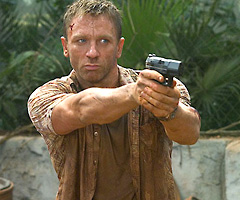
10)"Casino Royale" (Martin Campbell)- Granted that I've erased long stretches of "Casino Royale" from my mind -- Adios to the Miami airport sequence and the stairway brawl in Montenegro -- but the latest James Bond entry was far and away the year's most successful action. Daniel Craig was every bit as good as I'd hoped he would be, beating those Pierce Brosnan lean years into a lamentable, disappointing pulp. Throw in Eva Green as the best Bond Girl since I can't remember when and the requisite stunts and exotic locations and you have a 007 film worthy of repeat viewings.

9)"The Descent" (Neil Marshall)- Before Zap2it decided that movies weren't worth covering, I was subjected to 2006 films like "The Hills Have Eyes" and "Silent Hill" and "When a Stranger Calls" and "An American Haunting." None of those movies provided me with a single jolt, with a single nightmare, with a single moment of primal terror. With "The Descent," Neil Marshall had me nibbling on my fingernails and experiencing something resembling genuine fear. Horror-done-right is something worth respect.

8)"Down in the Valley" (David Jacobson)- ThinkFilm never figured out how to market this off-putting revisionist Western, though it's not as if it were ever destined to find a big audience. The great performances by Edward Norton, Evan Rachel Wood, David Morse and Rory Culkin are undeniable, but so too is the off-putting tone, that has the film careening between mismatched romance, gritty Valley realism and a perfect portrait of psychological confusion. Jacobson doesn't exactly grasp the pacing himself and the movie has a whiff of post-production tampering about it, but it's still smart and genuinely challenging.

7)"Half Nelson" (Ryan Fleck)- Thanks to Ryan Gosling, "Half Nelson" is a mostly-unflinching character study of addiction. Like Maggie Gyllenhaal's similarly strong turn in "Sherrybaby," though, Gosling's performance is occasionally undone by a screenplay that on one hand is too conventional by a half and then has to work extra hard to cheat a few expectations. But I kept watching Gosling's eyes and his mannerisms and his interactions with the well-match Shareeka Epps. Gosling's performance -- the year's best by a leading actor, regardless of what Forest Whitaker's supporters would have you believe -- often seems more carefully considered than the movie around it and he pushed any hints of sentimentality far into the background.

6) "Inside Man" (Spike Lee)/"The Departed" (Martin Scorsese): I'm putting these two together for several reasons. The first is that I'm not sure I liked either enough after one viewing to put them in the Top 10 alone, but I get the feeling that once I watch them again, they may get better. The second is that I like that after years of attempting to make Important movies, both Lee and Scorsese had their biggest commercial and critical successes in years by just making good-old-fashioned genre pictures, proving that a well-made thriller is a well-made thriller and shouldn't be taken lightly. And finally, I like pairing these together because, for my money, both Lee and Scorsese made better movies this year, but they just happened to be documentaries for HBO and PBS. Thus, "Inside Man" and "The Departed" get bonus points from "When the Levees Broke" and "No Direction Home."

STAY TUNED FOR NO. 5-THROUGH-1, NOT THAT I'VE KEPT ANY OF MY FAVORITES SECRET.

MovieWatch: "Venus"


"Venus"
Director: Roger Michell
Fien Print Rating (Out of 100): 66
In a Nutshell: I'm prone to over-analysis ("Well duh," says the peanut gallery), but there are most certainly movies you're better off just taking for their surface pleasures and backing away slowly. I'll put Roger Michell's "Venus" in that category. You can enjoy Hanif Kureishi's breezy and biting script about aging and sexuality. You can take great pleasure in the supporting performances by Leslie Phillips and Vanessa Redgrave. You can get a sense of discovery from watching adorably accented newcomer Jodie Whitaker. But mostly you can revel in the fact that when he isn't looking like a cadaver, Peter O'Toole is as alive on the big screen as he's been since the '80s (watching his eyes light up from within his sadly sagging flesh is almost miraculous). If you do those thing and then turn off your mind, I suppose it's easy to avoid just how vaguely icky the movie is.

Perhaps the most striking thing about "Venus" is how the film itself avoids passing judgment on the plot, which involves an aging actor and former lothario leching after a young (her exact age is never mentioned) grand-niece of his best friend. Kureishi's script never exactly determines if the movie is about a crumbling Don Juan's love for women outliving his libido, or just about the way a master manipulator takes a wild child and gets her to cook fish and learn to love posing nude. It's not quite "Lolita" and not quite "Lost in Translation" and not quite "Taming of the Shrew," but it contains ample elements from all three. And if you stop to ponder the lessons learned by any of the characters, your brain may hurt.

Couple side notes: Is Roger Michell the most schizophrenic of contemporary British directors? Try figuring out a career trajectory that includes "Notting Hill," "Changing Lanes," "Enduring Love" and "Venus" in less than a decade. Maybe that's why the visual and editing style of "Venus" never exactly gels. And would it be fair to think of Corinne Bailey Rae (whose songs bog the movie down at regular intervals) as an even more somnambulistic Norah Jones? And did the world need such a thing?

Saturday, February 10, 2007

MovieWatch: "The Lives of Others"


"The Lives of Others"
Director: Florian Henckel von Donnersmarck
Fien Print Rating (Out of 100): 71
In a Nutshell: Not quite as good as its supporters are declaring and if it beats "Pan's Labyrinth" for the foreign film Oscar, I may just shed a tear or two. It's a sturdier and more mature adult drama than anything made by an American filmmaker all year, with the possible exception of "Little Children." I would argue that it's mostly derived from a favorite genre of '70s filmmaking dealing with issues of paranoia, pervasive government control and the question of what it means to be a dissident and an individual and that if you compare it to something like "The Conformist" or "The Conversation," it comes up lacking in both craftsmanship and resonance.

Hmmm... That sounds too harsh, because "The Lives of Others" is far from an artistic disappoint. It's an amazingly evocative movie, capturing a chilly, atonal aesthetic best described as Iron Curtain Chic. Henckel von Donnersmarck (what a fantastic name!) and cinematographer Hagen Bogdanski create a GDR of grays and other muted tones, avoiding reds, yellows and oranges except in important symbolic contexts, with Ulrich Muhe's Stasi Agent Wiesler serving as the ideal representation of the ubiquitous, supposedly emotionless government. He looks like an outcropping of the cookie-cutter skyscrapers and generic tan or back automobiles. Of course, he finds his soul through his surveillance of non-subversive author and his actress girlfriend (Sebastian Koch and Martina Gedeck, matching Muhe).

Hmmm... That sounds too enthusiastic. How much of that evocation is based on a very conventional and predetermined idea of how to depict a certain kind of repressive regime? How much of Wiesler's character is based on a very archetypal sort of repressed foot soldier in his every action and character decision? And does the film's increasingly bittersweetly sentimental endings undermine some of what came before? And how much is the film's underlying misogyny an intellectual problem for me? The answer to each of those questions is "at least somewhat."

MovieWatch: "An Inconvenient Truth"


"An Inconvenient Truth"
Director: Davis Guggenheim
Fien Print Rating (Out of 100): 65
In a Nutshell: I'm a little bit late to the game on this one, but since I'm attempting to rush through the Oscar contenders I'd missed, I put in the necessary 90 minutes to enjoy Al Gore's impressively successful PowerPoint presentation. Here's a situation where we have to quickly distinguish between worthiness and quality. Maybe it's just that I'm in the process of plugging through Michael Apted's frequently brilliant "Up!" series via Netflix, but I'm currently inclined to require (request? desire?) more of a piece of documentary cinema than a clear-eyed slideshow mixed in with footage from the Al Gore 2008 presidential campaign mixed in with a commercial for the audio-visual capabilities of Apple computers. Despite Al Gore's reputation as vaguely robotic (a reputation that's never been deserved, despite it perpetuation by late night comics and Fox News pundits), "An Inconvenient Truth" is never boring and only occasionally less than persuasive. Gore manages to be both visionary and myopic -- he has his outline, corresponding to his slides and he never deviates, even to the exclusion of a complete telling of the story. Thus, Hurricane Katrina is presented as a tragedy caused by global climate change, despite the fact that the hurricane mostly *missed* New Orleans and the tragedy was really one of bureaucracy, faulty engineering and a particularly American head-in-the-sand approach to class and race, which you know Gore knows and just doesn't want to integrate into his presentation, as he were avoiding politicizing it, which is just silly. Really, I was constantly wanting to raise my hand to get clarifications or enhancements of certain things and the lack of that depth was a problem. I think Gore's attempt to universalize his message, to dumb it down, will play best to people who hadn't been concerned previously, but are inclined to agree.

Guggenheim's contributions in expanding the film from the stage are a problem as well. How many shows of Gore looking out care and plan windows in concern do we need? How many poorly integrated stories of tragedies or near-tragedies from his own life are necessary to make the point that he's learned to value our planet? Guggenheim should have noted what directors like Jonathan Demme and Steven Soderbergh did with the Spalding Grey monologues and treated Gore in the same manner. But yes, Global Warming deniers are pathetic morons. I get that. Accepting that fact, though, doesn't make "An Inconvenient Truth" a great documentary.

Friday, February 02, 2007

MovieWatch: "The Last King of Scotland"


"The Last King of Scotland"
Director: Kevin Macdonald
Fien Print Rating: 61
In a Nutshell: In the past week, I've seen three films in theaters -- "Babel," "Blood Diamond" and "The Last King of Scotland" and I have to say... ALRIGHT ALREADY! I GET IT! WHITE FOLKS IN AFRICA? BAD IDEA. Check. T.I.A. This. Is. Africa. Check. I get that we (my apologies for lumping myself in with all white folks) just don't understand the African ways and that by spending time in Africa, we only make things worse for everybody. I, of course, remember just a couple years ago when films like "Hotel Rwanda" tried telling me that the reason why things were bad in that particular African nation was that Bill Clinton (embodying the white man of the time) *didn't* go into Africa. I'd feel a bit more confident about these "Stay out of Africa, Honky" films if they weren't made by an American man, a Mexican man and a Scottish man, but still...

It's actually distinctly possible that of the T.I.A. trilogy that's dominated my past week, "The Last King of Scotland" was the one I liked the most, if largely for the magnificent and propulsive performance by Forest Whitaker, who in *no* way deserves the best actor Oscar. Sorry. If you're so clearly the second leading man in your own film, you're a supporting actor, no matter how charismatic and fiercesome you are and no matter how boring and cliche-ridden the movie might have been in your absence. Just as Jennifer Hudson and Abigail Breslin are really the leads in their respective films, Whitaker is a supporting player here, even if his Idi Amin is so dominant that you'd almost forget that the faun from "The Lion, the Witch and the Wardrobe" was getting an important lesson about staying out of Africa.

From what I gather, James McAvoy is essentially Scotland's answer to Zach Braff. He's playing the same part here that he played in the Narnia movie, a fact that I haven't heard mentioned enough. Like Mr. Tumnus, McAvoy's Nicolas Garrigan is a relative innocent lured in by a powerful leader and forced to betray his friends before being tortured. Perhaps what "The Last King of Scotland" needed was the Jesus Lion to save the day.

Anywho... I liked some of what director Kevin Macdonald and particularly cinematographer Anthony Dod Mantle accomplished here, finding a visual style that's partly documentary and party DOGMA. It's an aesthetic that doesn't necessarily match with Peter Morgan and Jeremy Brock's script, which is smart, but follows the conventional genre playbook throughout, deviating only for moments of extreme violence toward the end. But over what period is the story taking place? It could be a week, a month or three or four years? Time is measured in plot events, not character evolution. I also fear that Uganda itself becomes a marginal character in the film's second half, much to the overall message's detriment. Hmmm... The more I'm thinking about it, the less I'm liking it.

For my next vacation? Not Africa.

Saturday, January 27, 2007

MovieWatch: "Blood Diamond"


"Blood Diamond"
Director: Ed Zwick
Fien Print Rating (Out of 100): 60
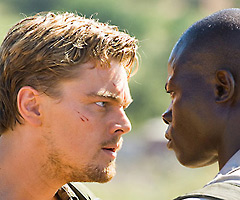
In a Nutshell: If Ed Zwick had a Barbie Dream Actor, it would probably be Djimon Hounsou. Just a hunch. Zwick has made a filmmaking career out of heart-tugging, action-oriented Important Dramas about white men in alienating environments learning Important Lessons. Hounsou has made an Oscar nominated acting career out of playing spiritual guide to alienated white men. Zwick meet Hounsou. Hounsou meet Zwick. Now give us free!

Zwick and Hounsou's first pairing, "Blood Diamond," is a well-meaning and old-fashioned yarn with just enough adventure and violence for the steak-eaters and just enough politics and family pride for the tree-huggers. Cast Robert Mitchum or Humphrey Bogart in the Leonardo DiCaprio role and Deborah Kerr or Katharine Hepburn in the Jennifer Connelly part and John Huston could have made the heck out of this movie in 1953. The problem is that they don't really make movies like this anymore, so Zwick is frequently clumsy. He never lets the actors, the plot or the narrative take priority over a well-composed valley vista or a breath-taking sunset (kudos to Eduardo Serra's gorgeous cinematography). The central romantic pairing is implausible and badly integrated into the plot, with Zwick slamming on the breaks to give Connelly and DiCaprio pleasing glamour shots between scenes of poverty or bloodshed.

One of the big questions on Oscar day -- asked only somewhat more than "How the heck did 'Click' come to get an Oscar nomination?" -- was "How did DiCaprio get his nomination for 'Blood Diamond' instead of 'The Departed.'" Having seen first-hand the misleading messages sent out about DiCaprio's role in the Scorsese film -- Is it a lead role or supporting?!?!? -- I wasn't shocked and after seeing this film, I'm comfortable with the choice. DiCaprio's Afrikaans accent here was much less distracting than his Bah-ston accent in "The Departed" and he keeps his roguish character admirably conflicted. Hounsou's Oscar nod seems to have been given on the basis of pure exertion -- he has a gift for over-emoting without looking like he's over-acting. [A bigger question on the Oscar nod front is the sound editing nomination, given that I was distracted by sloppy ADR on several occasions...]

"Blood Diamond" gets engulfed in sentimentality well before its predictable ending, and goes through five or six fake endings before the credits role (over a truly *awful* Nas composition). But I wasn't bored and, unlike the movie I saw yesterday, I didn't leave feeling like I'd been emotionally violated. Bravo!

Friday, January 26, 2007

MovieWatch: "Babel"


"Babel"
Director: Alejandro Gonzalez Inarritu
Fien Print Rating (Out of 100): 48
In a Nutshell: With good ol' fashioned porn porn, you know what you're getting as an end result. What, I'm tempted to wonder, is the intended end result of misery porn like "Babel" and who are the soft-headed people who get off on this stuff? You know how in "American Beauty," the Wes Bentley character has that ultra cheesy moment with the plastic bag and he gasps, "Sometimes... there's... so... much... beauty... in... the... world... I... feel... like... I... can't... take... it..." "Babel" like the very opposite of that, like Alejandro Gonzalez Inarritu is so overwhelmed by all the misery in the world that he just can't take it. The movie is about the tapestry of tragedy and miscommunication that tie us all together, as if the common thread of globalism in the 21st Century were basically a primal wail of discontent and unease. Blech.

"Babel" wouldn't be so insufferable and unbearable an experience if Inarritu weren't such a clearly gifted filmmaker. That's the quality that sets "Babel" apart from "Crash," frankly -- The web of coincidences, petty ironies and caricatured characters here are presented by a man of cinematic talent with an awareness of the medium. That's why "Crash" is laughable and "Babel" is harder to dismiss, but also harder to sit through. Like "Amores Perros" and "21 Grams" before it, "Babel" is well-acted across the board (the presence of movie stars Brad Pitt and Cate Blanchett in one narrative is distracting, but becomes an imbedded commentary about the artistic imperialism and entitlement of Hollywood) and thanks to DP Rodrigo Prieto, it looks great. It's also numbing from the end of the first scene as two Moroccan boys playing around with a rifle set off a chain of unhappiness. I spent so much time dreading the next misfortune, but I wasn't invested in any of these people or their plights. They were pawns being pushed around a board by screenwriter Guillermo Arriaga, whose "Three Burials of Melquiades Estrada" script was both his best crafted and most humane (and a better meditation on linguistic and cultural borders, frankly).

Was this misery porn supposed to yield catharsis? I got no release. It's a dirge. A mood piece with only one tone. Is it your best picture Oscar winner?

I can't help but find it sad that of the 2006 films by the Three Amigos (Inarritu plus Guillermo del Toro and Alfonso Cuaron), *this* is the one nominated for best director and best picture. Sigh.

Monday, January 22, 2007

My Oscar Nominations Wish-List

When the Oscar nominations are announced on Tuesday (Jan 23) morning, none of these will make the cut. They should, darnit.

Rian Johnson, best original screenplay for "Brick" -- It's shouldn't work. High school students talking like rejects from a Raymond Chandler novel, trying to solve a mystery that I don't understand despite seeing the movie multiple times in the theater. But the dialogue, complete with created slang and near-Mamet rhythms, often seems to sing, making actors like Joseph Gordon-Levitt and Lukas Haas seem plausibly tough and hard-boiled.

"The Aura" for foreign language film -- Did anybody see Fabian Bielinsky's bizarre thriller about a narcoleptic taxidermist forced to mastermind the perfect crime? It's a pity. The late director of "Nine Queens" turned in the kind of intellectual puzzle picture that David Mamet turns in at his best. Throw in a great performance by Ricardo Darin and you have Argentina's Oscar submission, so at least it's eligible.

"Dave Chappelle's Block Party" for documentary feature -- If the odds of every other ideal nomination here taking form are *near* zero, they're still better than this one. Michel Gondry's subversively political, unexpectedly hilarious, exuberantly musical concert flick wasn't even on the documentary branch's short-list, meaning that the year's best non-fiction film is fated to join docs like "Grizzly Man" or "Hoop Dreams" on the too-good-for-Oscar list.

"Click" for outstanding makeup -- While "Block Party" may not have made the Academy short-list in its main category, "Click" was announced as one of the potential finalists in the make-up field. The old-age make-up in "Click" was horrible, as was the film itself. The idea of it earning an Oscar nomination just makes me giggle. Sorry.

Wally Pfister, outstanding cinematography for "The Prestige" -- As Christopher Nolan has grown more confident as a cinematographer, he's brought Pfister along with him, as the DP has grown ever more assured. Or perhaps it's the other way around. "The Prestige" is a beautifully made on every level, full of memorable images, none moreso than the field of light-bulbs charged from the ground, as lovingly composed a frame as I saw at the movies all year. "The Prestige" is a near-brilliant movie about illusion and Pfister was complicit with Nolan on every level, weaving the magic.

"Marie Antoinette" best costumes (because outstanding achievement in cinematic pastry isn't available)-- With "Marie Antoinette," Sofia Coppola may have made the year's most superficial film, but that doesn't mean that you can't give awards to those pretty surfaces. Heck, no film last year won more Oscars than "Memoirs of a Geisha."

Warren Ellis and Nick Cave, best original score for "The Proposition" -- Perhaps the year's finest 100 minutes of pure mood, John Hillcoat's mediation on human savagery flowed by like a haunting dream, punctuated only by moments of extreme violence. The violence sold itself, the backwards-looking score sold the rest of the movie.

Ellen Page, best actress for "Hard Candy" -- I think the genius of her performance is that even after all of the facts were revealed and everybody's motivations were laid out on the table, I still wasn't sure if I was supposed to believe that she was who she said she was and I built an entirely different backstory in my head based on details from the performance. What I'm saying is that she was good enough that she created an entirely world around her character and that's kinda cool for a tiny Canadian gal.

Edward Norton, best actor for "Down in the Valley" -- I thought Norton gave one of his worst performances in "The Illusionist" and I still haven't seen "The Painted Veil," but he did vintage work in "Down in the Valley," not that anybody saw David Jacobson's warped vision of The Valley as a Western frontier town, with Norton as the last outlaw hero. At times charming and sympathetic, at other times charming and off-his rocker, Norton created a portrait of complete self-denial and self-illusion.

Alfonso Cuaron, best director for "Children of Men" -- Watch the entire 'Fugee camp sequence, an unflinching and kinetic depiction of hell-on-Earth, and tell me how any director could have done it better.

"Pan's Labyrinth" for best picture -- Magic. Pure and simple. The idea that a contrived and utterly mediocre indie-by-numbers comedy like "Little Miss Sunshine" will be nominated for best picture but the best film I've seen in three or four years will have to pick up scraps is part of why nobody with any sense takes the Academy seriously.

Tuesday, January 02, 2007

The Best and Worst Best Actress Oscar Winners?


Edward Copeland, who keeps threatening to rename his blog something other than Edward Copeland on Film, is compiling a survey on the best and worst Oscar winners for Best Actress. You may recall Edward's fantastic best picture winner survey earlier this year.

Because I'm an agreeable and helpful blogger, I've done my best to participate, though looking through the list of winners, I was shocked to realize how many of the honorees from the '30s, '40s and '50s I've managed to miss. Thus, if it turns out that Jennifer Jones ("The Song of Bernadette"), Helen Hayes ("The Sin of Madelon Claudet) or Shirley Booth ("Come Back, Little Sheba") deserve places on either of these two lists, I've been obviously delinquent.

I put the worst first here, because it was just a more competitive race. Skim through my choices and then feel free to zip over to Edward's site and submit your own opinions.

THE WORST:

1 [the worst]) Helen Hunt, "As Good As It Gets" (1998)- It's almost impossible to figure out what point the Academy was making with this award. Was it that TV actors are people too? Or was it just that Hunt was the only American against four far superior Brits (Julie Christie, Judi Dench, Kate Winslet)? Hunt's punishment came the next year when she presented Robert Benigni with the least deserved best actor trophy in Oscar History.

2)Katharine Hepburn, "On Golden Pond" (1982)- This takes nothing away from her other Oscars, frequently (but not always) deserved, but I shouldn't be laughing so hard at a performance that isn't intended to be funny.

3)Nicole Kidman, "The Hours" (2003)- Plenty of other best actress wins have come for supporting roles, but none have ever come for supporting roles fueled by a bad English accent and a putty nose.

4)Jessica Lange, "Blue Sky" (1994)- Perhaps the worst year for actresses in Hollywood history. Jessica Lange may have been twitchy and over-the-top in a truly bad movie, but her competition included Jodie Foster for "Nell" (Ouch) and Susan Sarandon for "The Client" (Really?) and Winona Ryder for "Little Women" (REALLY?!?!?)

5)Audrey Hepburn, "Roman Holiday" (1954)- Many supporting actress Oscars have been given just for being adorable and winsome, but how many lead trophies have been presented merely for being tremendously loveable? Oh and don't take this as a sign I don't like the performance or the movie, but is it really Oscar-worthy? [In retrospect, perhaps the greatness of this performance is in how bad I feel about listing it here?]

THE BEST:

1)Meryl Streep, "Sophie's Choice" (1983)- If you're grading on "Degree of Difficulty," this performance is impossible to top.

2)Jodie Foster, "The Silence of the Lambs" (1992)- It's a very internalized turn, but I admire it for this reason: Going opposite one of the hammiest best actor performances in history, Foster never loses control or ceases to hold every shot. That's impressive.

3)Jane Fonda, "Klute" (1972)- Oscar voters love to honor beautiful women for playing prostitutes, which may be the Academy's attempt to encourage other beautiful women to enter the Oldest Profession. Of all the Oscar-winning portrayals of hookers, though, this is the best.

4)Elizabeth Taylor, "Who's Afraid of Virginia Woolf?" (1967)- I don't always like broad theatricality and shrieking, but for some reason this performance has an emotional core for me, even if Taylor is shouting to the back row at all times.

5)Claudette Colbert, "It Happened One Night" (1935)- Maybe not the most technically complicated of performances, but I just love the idea of an Oscar going for this kind of work. This goes on the list of most random Oscar-winning performances along with Julie Andrews in "Mary Poppins," Diane Keaton for "Annie Hall" and Kathy Bates for "Misery." Those three are great performances as well, but I'm going with Colbert here just for the historical value.

Monday, January 01, 2007

Dead... Tragic and Funny

While civilians die in numberless anonymity or in tragic handfuls, it's a well-known fact that celebrities die in threes. While I was overseas, that Rule of Three played out in full effect with what is quite possibly the strangest Trinity of Death ever assembled with James "The Hardest Working Man In Show Business" Brown, Gerald "The Least Elected President In History" Ford and Saddam "Co-Star of 'The Big Lebowski'" Hussein. It's the semi-unexpectedness of Hussein's execution (does that tamper with Death Pool rules?) that pushes this week's Deceased Trifecta ahead of the month's earlier odd menage a trois of Augusto "Where Have All The Dictators Gone?" Pinochet, Peter "Puttin' On the Ritz" Boyle, and Joseph "Ugly Animation" Barbera.

Really, though, I'm only posting about these dearly departed celebrities as an excuse to start the new year with the posting of my favorite YouTube clip from last year, Chiranjeevi's celebration of Michael Jackson's thriller. Forgive me for wasting quality blog space on recirculated clips, but this still makes me giggle and what better way to start the New Year than with a giggle? [I also like to periodically break up the litany of "MovieWatch" posts.]

Sunday, December 31, 2006

MovieWatch: "The Good Shepherd"


"The Good Shepherd"
Director: Robert DeNiro
Fien Print Rating (Out of 100): 73
In a Nutshell: Back after 10 exhausting days in Europe, which forced the New Year's Eve question of "If there are a dozen movies I want to go see and my filmgoing partner of the afternoon won't want to see the tearjerking underdog sports movies I wanna see -- Sorry, "Rocky 6" and "We Are Marshall" -- and I'm too darned jet-lagged to wanna go see a movie that requires reading -- Sorry, "Letters From Iwo Jima" -- or potentially frustrating emotional manipulation -- Sorry, for the 100th time, "Babel" -- what's out there as a compromise?" The answer was Robert DeNiro's second directing effort, a frequently fascinating and textured peek at the early years of the CIA that I was captivated by for around 90 minutes before I tired.

Eric Roth's script does the difficult things very well. It plunges viewers into the world of pre-WWII intellectual privilege -- Yale, Skull & Bones -- and shows how one man, Matt Damon's Edward Wilson, came to develop and launch a prodigious intelligence body. Full of skullduggery, vaguely familiar characters and international intrigue, "The Good Shepherd" has more density and complexity than most films could dream of. It's also a bloated 2-hours-46-minutes and could have been shorter if Roth's script hadn't kept explaining its subtext and over-articulating how Wilson's own life was a prism for the missteps in the CIA. There were a half-dozen times when I thought "Hmmm... I guess I understand how that fits with the films themes" and then waiting two or three minutes to have a character -- too often DeNiro's Gen. Sullivan -- explain those themes in a monologue that would only be necessary if the movie was playing to an audience of monkeys. DeNiro's failure to trust viewers to connect the dots in many crucial scenes probably came about after testing a variety of different cuts of the movie, but it isn't the right result.

I'm also tempted to wonder if "The Good Shepherd" wouldn't have worked better if it had been structured along the "Iris" model and double-cast most of the lead roles, despite the fact that the characters age less than 25 years. Instead, Damon is both the oldest looking Yale Man imaginable and the most boyish 50-year-old on the planet, believable as neither despite a determined and emotionally guarded performance. And Jolie has similarly forfeited the ability to play a coquettish co-ed and her aging matron is full of tics and limps and postural shifts that suggest Jolie will make a poor grandmother indeed.

Couple quick other things: Can it ever be said enough that Alec Baldwin is just about the most valuable supporting actor on Earth? And if he isn't, might Michael Gambon be? And who knew Billy Crudup was so darned British? Or that Keir Dullea was still alive? Or that it would be so nice to see Joe Pesci on the big screen again?

On a side note: I hope to get to a bundle of movies in the next week before Press Tour begins, but with an impending move (next door, so it shouldn't involve huge tsuris) I may not have the chance. I'd still like to remind folks to go see the year's two best movies -- "Pan's Labyrinth" and "Children of Men" when they get to a theater near you. Otherwise, we're just going to be stuck with "Night at the Museum" sequels. Nobody wants that. Oh wait. They do? Sigh.

Tuesday, December 19, 2006

MovieWatch: "Children of Men"


"Children of Men"
Director: Alfonso Cuaron
Fien Print Rating (Out of 100): 87
In a Nutshell: I've got a plane to catch, so this is going to be ultra-brief. Think "Casablanca" meets "The Nativity Story" as written by Philip K. Dick and directed by some unholy spawn of early Stanley Kubrick and Emir Kusturica. If "Pan's Labyrinth" remains the year's signature piece of pure storytelling, "Children of Men" is the year's best piece of feature filmmaking. Some people will complain that it's heavy-handed and they won't necessarily be wrong. It's a fable about hope and government oppression. There'd be no point in it being subtle. The film's first half -- establishing the world of 2027 in which all women have become infertile and humanity is on the verge of collapse -- is very fine, but the second half -- set mostly in a remote Refugee Camp -- is mind-blowing. Cuaron and cinematographer Emmanuel Lubezki have constructed shots of unbearable suspense and stark beauty and Clive Owen is just asked to hold the frame and be a leading man, which he is. The soundtrack -- lots of '60s remakes and originals and a Jarvis Cocker credit song that would make a great Oscar night performance -- is killer and the performances around Owen are strong as well. I imagine that "Children of Men" will be tucked in after "Pan's Labyrinth" on my Top 10. It's a meaty piece of cinema and I look forward to seeing it again.

Saturday, December 16, 2006

MovieWatch: "The Pursuit of Happyness"


"The Pursuit of Happyness"
Director: Gabriele Muccino
Fien Print Rating: 68
In a Nutshell: The title of "The Pursuit of Happyness" -- or as I'd rather call it "Run, Will Smith, Run" -- has been under scrutiny, with most of the discussion concentrating on the misspelling of "happiness," a typo found on the door of a Chinatown daycare center where Will Smith's Chris Gardner sends his son. Not enough emphasis, I reckon, as been put on the other word in the title, "pursuit," which is really what the movie is about. As Smith's Gardner says early in the movie, the Declaration of Independence makes no promise of happiness. It just suggests that the ability to pursue happiness is an inalienable right.

"Happyness" is actually a good companion piece to the inspirational Disney football drama "Invincible," which I viewed as a surprisingly un-mawkish and dreary glimpse of a Cinderella story that concentrated more on the mire than on the triumphant exit. Directed with a poetically realistic sense of purpose by Gabriele Muccino, "Happyness" offers precious little by way of triumph until its conclusion, which is bound to surprise a lot of viewers excepting something more Hollywood, more consistently uplifting. Perhaps the least shocking thing about the film is that it was scripted by Steve Conrad, whose "The Weather Man" was as complicatedly depressing a film as any major studio has released in recent memory. He was brought on here, no doubt, to keep "Happyness" from wallowing in sentimentality and it mostly doesn't.

Instead, it becomes a litany of the misfortunes that befall Garner on his journey from homelessness to millionaire success as a stock broker. There are at least a half dozen sequences of Smith sprinting away from angry cabbies, sprinting after people who stole his bone density machines and sprinting toward business meetings that he may or may not ever make. And the gloominess does, rapidly, become redundant and, in that redundancy, it becomes distasteful. In fact, if *any* other actor had played Gardner, the movie would have collapsed under the weight of its discontent, but Smith shoulders all of his character's burdens and with them the weight of the whole movie. Casting Smith's son Jaden as Gardener's son was a stroke of absolutely genius because of the movie is all cold visuals and numbing disappointments, the warmth between father and son -- the heart of the story -- can't be faked. Frankly, they should have cast Jada Pinkett Smith as Gardner's bitter, abandoning wife, because poor Thandie Newton gets engulfed by the thankless and distasteful part. I think they could have trimmed about 10 minutes worth of Thandie's shrill harpie and the movie wouldn't have lost a thing.

I don't know if I'm conveying well enough why I liked the movie beyond Smith's performance, but I guess I felt like by the end, Muccino and Smith had mostly earned the misty eyes and sniffles that filled the theater. That being said? No interest in seeing this one again at any point.

Friday, December 15, 2006

MovieWatch: "Charlotte's Web"


"Charlotte's Web"
Director: Gary Winick
Fien Print Rating: A sentimental and *generous* 60
In a Nutshell: To really and truly know me, you need know only two things: The Red Sox's current absence of quality late-inning relief pitching is keeping me up at nights and I love movies featuring talking pigs. Take a couple seconds to parse that and get back to me.

That's why when it became too late to catch the showing of "Babel" that I'd hoped to make tonight (no comment), I dispatched with the other unseen suspects -- Leo whining about diamonds, 50 Cent whining about Iraq, Eragon whining about the difficulties of riding a dragon -- and opted for "Charlotte's Web."

My simple, short and superficial reaction is that it's a painlessly cute movie, one that kids should enjoy and that adults should tolerate provided they have sufficient nostalgia for the E.B. White classic, or a sufficient taste for talking pigs. My Favorite Martian Dakota Fanning provides solid human support to the strong voice cast lead by Julia Roberts, who makes a maternal and nurturing Charlotte, and Steve Buscemi's Templeton the Rat, who may not be Paul Lynde, but who is? Pushed forward by a Rachel Portman-esque Danny Elfman score (which is to same hammy, magically and literary, but almost understated by Elfman standards), the movie builds to many of the right emotional notes.

My shorter and simpler reaction: "Babe" is a magnificent movie, perhaps the greatest ever made for kids and "Charlotte's Web" is unavoidably in its shadow. Heck, while Charlotte's Web" may be twice as good as "Gordy," it's no "Babe: Pig in the City" either.

From "Tadpole" to "13 Going on 30," Gary Winick has proven himself to be amongst the least visual of mainstream directors, so if visual magic was necessary to make "Charlotte's Web" a big screen classic, then the failings are Winick's. How many shots are static, without any point of view or perspective? More than I'd care to count. And the animals? They rarely move and they look either animatronic or drugged, rarely real. The visual effects are never transparent and the straight forward computer animated stuff -- Charlotte in particular -- is better than the integration of actual animals and effects, especially since the art of animal lip-flap (making critters look conversational) hasn't improved at all in the past decade.

And last and probably least for the evening, it's disturbing that Dakota Fanning has been given a love interest in the movie. She's not yet at the point where I'm prepared to see her as a human, much less as a human of necessary romancin' age.

Wednesday, December 13, 2006

R.I.P. Peter Boyle (1935-2006)

Since I never really cared for "Everybody Loves Raymond," my associations with Peter Boyle are mostly from that brief period in the 1970s, when his balding, bird-like features (and surprisingly hulking body) made him the embodiment of a certain edgy aesthetic that defined the period. He was fantastic in films from John G. Avildsen's under-remembered "Joe" through "Taxi Driver" and "Hardcore."

At the end of the day, though, for all of those dramatic turns, the best way to pay tribute to Boyle is to post this clip from "Young Frankenstein." For my money, it's one of the 10 funniest moments in cinema history.

Friday, December 08, 2006

MovieWatch: "The Fountain"


"The Fountain"
Director: Darren Aronofsky
Fien Print Rating (Out of 100): 48 (59 if high)
In a Nutshell: [I saw this one nearly a week ago, but my ambivalence was so great that it took til now for me to feel like writing even the briefest of reviews.]
We were infinitely far into "The Fountain" (for time and space matter not with such ephemeral and negligible narrative) and beautifully lit, temporally and terminally frustrated lovers Hugh Jackman and Rachel Weisz started whispering in each other's ears. "Forever," "Forever," "Forever," they whispered as they floated weightlessly in a snow-globe meant to represent Earth, humanity, life, death, frailty and other nebulous themes. Suddenly it struck me that I wasn't waiting for action or catharsis or for something -- ANYTHING!!!! -- to actually happen. I was waiting to find out what the movie was a commercial for.

"Forever."

"Forever."

"Forever."

"The Fountain, Darren Aronofsky's new fragrance for doomed women and passionate, soulful men."

Au d'toilet, indeed.

Or...

"Forever."

"Forever."

"Forever."

"DeBeers' new diamonds... Even if you discover the Tree of Life, they'll last you forever."

Instead, "The Fountain" is a 96-minute piece of product placement that doesn't even have a product to sell, unless you're buying into its crushingly superficial lip service to the ideas of everlasting love, the redemptive and saving possibilities of death and the advantages of animal testing. It's a very sweet, but somewhat sophomoric little mood poem from Aronofsky to the woman he'd impregnate. But it sure isn't deep and it sure isn't profound, because if it were either of those things, I suspect its pretentiousness would have annoyed me. Instead, I invested some time in ogling its technical merits and was neither enthralled nor irked.

Aronofsky is a talented filmmaker and with cinematographer Matthew Libatique, he's crafted imagery so gorgeous that I often found myself frustratedly praying that meaning would arrive to compliment the aesthetic passion. [I won't even complain that Aronofsky consistantly confuses stylistic redundancy with the creation of visual themes, a problem that's plagued all three of his movies.] Certainly the actors are buying into it. Jackman gives his second consecutive sterling performance after his recent turn in "The Prestige," proving once again that the problem with movies like "Swordfish," "Kate & Leopold," "Someone Like You" and "Van Helsing" wasn't the ability of their leading man. He invests Aronofsky's trio of thinly written characters with a wounded and wonder-filled heart. Weisz merely asks Jackman's various characters to fall in love with her, which has to be an easier chore than inhabiting an actual character, particularly if the director has fallen in love with you.

I have no doubt that 10 years from now, "The Fountain" will have a select group of stoners and romantics who think it's a misunderstood masterpiece. They won't be right, but I wouldn't mind partaking in whatever they're smoking.

Friday, December 01, 2006

MovieWatch: "Deja Vu"


"Deja Vu"
Director: Tony Scott
Fien Print Rating (Out of 100): 59
In a Nutshell:[This review discusses the film's ending in nebulous terms, but it *does* discuss its ending. Be advised. Be very advised.]
After suffering through the last hour of "Domino," it's hard to make me feel sorry for Tony Scott, but after seeing "Deja Vu," I kinda do. You're Tony Scott and your orchestra an expensive, twisty, high concept thriller and you leave it with the studio and then you happen to catch the extended trailer and... DEAR LORD! The studio decided that it was a good idea to include the movie's very last line in its promotion. Now since I mostly don't cover movies anymore, I walked into "Deja Vu" knowing absolutely nothing about the movie except what I'd seen in the trailers, but I *had* -- unavoidably -- seen the trailer and the movie must have been 15 minutes in before I realized, from the trailer, how every single step of the movie was going to progress from there. Yeah, "Deja Vu" was a tough movie to market but geez... Given that it made an underwhelming $28-million-plus in its first long weekend, Buena Vista obviously bungled the job on several levels.

It's disappointing, because for much of its running time, "Deja Vu" is a dazzling and dizzying thriller that runs in enough circles to obscure its mostly illogical time-loop premise that plays like "Day Break" meets "Enemy of the State" meets every single movie in which Denzel Washington plays that one good cop going on a crusade against the corrupt system. The movie cheats many rules of Hollywood structure in that the time travel aspect -- given away in the trailer, naturally -- doesn't kick in until well past the half-way point. In fact, Denzel's tip-toeing through the timeline is the least interesting part of the movie, so thin and uninvolving from a character and emotional standpoint that even if you *didn't* reverse-engineer the movie based on the trailer, you'd probably walk out a little flat.

It turns out that plot is king here, which isn't surprising. What is surprising is just how thin all of the characters are. Denzel is a AFT agent. Nothing more or less. The lovely Paula Patton is the innocent woman in the middle of things. Nothing more or less. Although the cast is loaded with familiar character actors who have played surprise villains in the past, the actual villain behind an impressive ferry explosion is just a fanatical wacko, a McVeigh-inspired "Patriot" without any backstory or extra motivation. Since it's an over-priced B-movie, you forgive that stuff.

Scott exploits Hurricane Katrina marvelously, tying the film's New Orleans setting in with its major theme -- some tragedies (killer storms, for example) can't be prevented, but how far would you go to prevent a hypothetically preventable disaster? New Orleans is used mostly for background flavor, with a large portion of the film taking place in a high tech trailer. The second unit took a trip to the ruins of the Ninth Ward for a jaunt that barely ties to the plot.

If the Disney marketing department hadn't spoiled the entire movie for me, I honestly can't say how it might have played differently. I guess this goes under the heading of Things I Can't Go Back In Time To Change. Nuts.